
Because food is not grown in a vacuum (except on the Space Station), fruits, veggies, chickens, cattle, and fish are exposed to environmental contamination during their life spans. Even controlled or sheltered conditions, like a greenhouse, are likely not free of environmental contaminants present in the building or soil and brought in by irrigation water. As discussed in the prior post, toxic chemicals can be transported to our food through air currents and rain, in waterways like rivers, groundwater, or oceans, and may be present in soils and river sediments where crops are grown and animals graze or swim. However, there are some things you can do to reduce your exposure to environmental contaminants – check out the “What you can do” section at the bottom of this post.
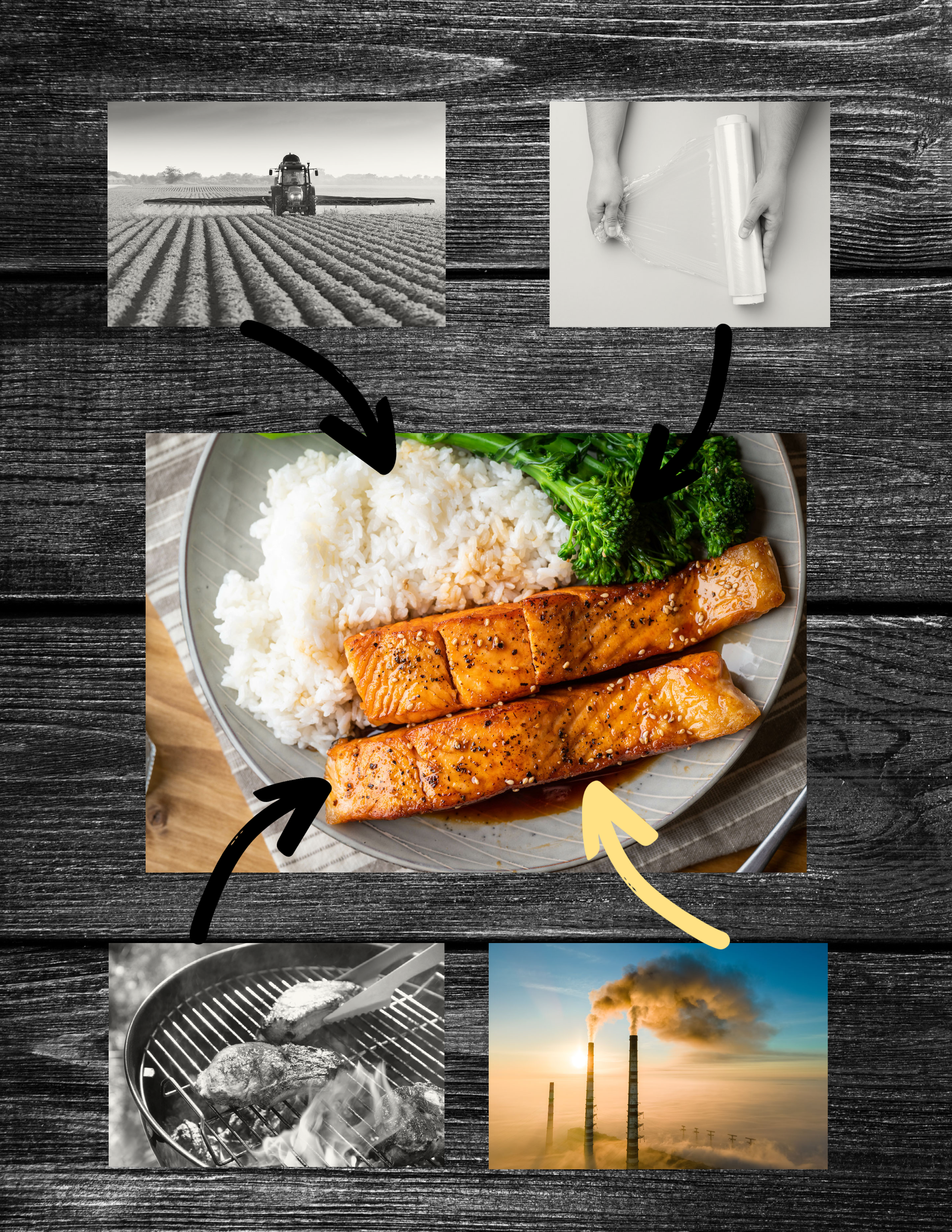
Most environmental chemicals of concern are produced by us, then contaminate the environment. Though some, like arsenic, may occur naturally in groundwater. Chemicals of concern may have been mostly produced in the past, like PCBs, dioxins, and some organochlorine pesticides. Or they are currently produced and present in industrial and municipal discharges, pesticide use on fields, parks, or lawns, or emitted as exhaust from cars, trucks, trains, and airplanes.
With airborne contaminants, a key factor that determines how vulnerable our food is to contamination is whether sources are located upwind. Contaminant sources can be fairly close, like roadways and farm fields, or regional, like a power plant or industrial facility, depending on how close you live. They can even be quite distant, such as when the Chernobyl nuclear reactor exploded in 1986, contaminating hillsides and sheep grazing thousands of miles away in the UK with radionuclides.1
Waterborne contaminants can contaminate our food through irrigation and by exposing fish swimming in rivers or the ocean. Waterways can be contaminated by effluent from industry, agricultural runoff, urban and suburban runoff (pesticides, fertilizers, heavy metals), as well as treated sewage effluent (pharmaceuticals, nutrients).
The soil in which fruits and veggies are grown, as well as where cattle and other animals graze, can be contaminated through atmospheric deposition, historical use of chemicals on the site, like old fruit orchards treated with arsenic, and application of biosolids (sewage sludge), which may contain chemicals such as cleaning and personal care ingredients, pharmaceuticals, and PFAS that weren’t destroyed during treatment. Many of these chemicals can be translocated into edible parts of plants.2
Finally, rivers can retain sedimentary reservoirs of toxic chemicals from historical contamination, as well as current sources. These may have entered the river both by direct discharge and runoff from watersheds. This is most important for fish, which may graze on flora and fauna growing in the sediments and bioaccumulating contaminants such as PCBs and mercury.
What you can do
- Choosing organic produce will not only reduce pesticide content in your food, but also other chemicals of concern that are present in biosolids, which are not allowed on fields certified organic.3
- You don’t have to buy all organic: two resources for which produce is most contaminated and thus avoid are EWG and Consumer Reports.
- To remove some arsenic from rice, particularly brown rice which has been shown to be more contaminated, either soak rice then rinse prior to cooking or cook in excess water then pour that off.4,5
- Eat lower on the food web, e.g. more plants than animals, to reduce presence of bioaccumulated historical contaminants like PCBs, dioxins. See this post for more details.
- Use the NRDC’s guide for selecting less contaminated fish.
- If your home garden is located near a heavily trafficked road or other contaminant sources, planting tall vegetation nearby can help reduce that contamination. For other suggestions, check out this post.
- For safer foraging, check out this post.
References
- Hickman, L. (2009). Sheep farmers still stuck under a Chernobyl cloud. The Guardian.
- Wu, C. et al. (2010). Uptake of pharmaceutical and personal care products by soybean plants from soils applied with biosolids and irrigated with contaminated water. Environ. Sci. Technol. 44:6157-61.
- USDA (2011). Organic 101. What organic farming (and processing) doesn’t allow.
- Gray, P. J. et al. (2015). Cooking rice in excess water reduces both arsenic and enriched vitamins in the cooked grain. Food Additives & Contam. Part A. 33:78-85.
- Zhang, F. et al. (2020). Effects of soaking process on arsenic and other mineral elements in brown rice. Food Sci. and Human Wellness. 9:168-175.
Index to terms
- PCBs = polychlorinated biphenyls
- Dioxins = polychlorinated dibenzodioxins
- PFAS = per- and polyfluoroalkyl substances
 Dr. Laurel Standley